
Brakes are polite. They almost never fail without warning: they squeal, grind, shudder, pull or sink first, sometimes for weeks. The problem is that most drivers cannot tell which of those noises means “book it in next week” and which one means “do not drive this to work tomorrow.”
This is that translation, written from what we actually find on the lift at our shop on Fenkell Ave. Nothing here needs tools or a jack. It is all things you can hear, feel or see from the driver's seat.
A high squeal that comes and goes with light braking
What it usually is: the wear indicator. Most pads have a small steel tab fitted at a set depth into the friction material. When the pad wears down to roughly 3mm, that tab starts touching the rotor and makes a deliberate, irritating squeal. It is not a fault. It is an alarm clock, engineered in.
How urgent: not an emergency, but it is a countdown. Depending on how you drive, you have somewhere between a few hundred and a couple of thousand miles before the friction material is gone and the backing plate starts cutting into the rotor. That is when a pad job turns into a pad and rotor job.
The exception worth knowing: a squeal only on the first two or three stops of the morning, which then vanishes, is almost always surface rust burning off the rotor face overnight. Michigan humidity and road salt make this extremely common between November and April. If it clears within a mile of driving, it is nothing.
A grinding, scraping, metal-on-metal sound
What it usually is: the friction material is gone and the steel backing plate is now pressing directly on the rotor. Some people describe it as a growl, some as a sound like gravel in a can.
How urgent: this one is the same-day one. Two things are happening at once. Your stopping distance is getting longer, and every mile you drive is machining a groove into a rotor that was probably still serviceable when the squeal started. A pad set is one price. A pad set plus rotors, and sometimes a caliper that overheated because it was working against bare steel, is a very different price. If your brakes are grinding, the cheapest thing you can do is stop driving on them.
Grinding that only happens at very low speed, when reversing, or with a rhythmic click can also be a loose brake hardware clip or a rock caught between the rotor and the dust shield. That one is a five-minute fix, but it needs the wheel off to tell the difference, which is why we do not guess at it over the phone. Our brake service page covers what that inspection involves.
Shaking or pulsing when you slow down
What it usually is: a rotor that is no longer flat. The wheel shimmies in your hands, or the brake pedal pushes back against your foot in a steady pulse, and it gets worse the harder you brake from higher speed. Rotors distort from heat, from uneven pad deposits, and sometimes from lug nuts that were rattled on unevenly with an impact gun.
How urgent: not dangerous immediately, but it will not get better on its own and it wears the new pads unevenly. Worth booking within a week or two.
Do not confuse it with: a shimmy that is there all the time, not just under braking. That is usually a wheel balance or a suspension issue rather than a brake issue, and it belongs on our tires and alignment page instead.
The car pulls to one side as you stop
What it usually is: one side is doing more work than the other. The most common cause we see in this climate is a seized or sticking caliper slide pin. Road salt corrodes the pins and boots, the caliper stops releasing cleanly, and that corner drags. Sometimes you can smell it after a drive, a hot metallic smell from one wheel, or find one wheel noticeably hotter than the other three.
How urgent: within days. A dragging caliper cooks its own pads and rotor, kills fuel economy, and in the worst case can leave you with a badly overheated wheel end.
Do not confuse it with: a pull that is there under normal driving too, with no brakes applied. That is alignment or tire pressure, not brakes.
A pedal that feels soft, spongy, or sinks toward the floor
What it usually is: air or moisture in the hydraulic system, a fluid leak, or a failing master cylinder. Brake fluid absorbs water out of the air over time, and water boils at a far lower temperature than fluid does. Boil it on a long downhill or in stop-and-go traffic and the pedal goes soft exactly when you need it most.
How urgent: the most urgent symptom on this page. A sinking pedal is a hydraulic problem, and hydraulic problems do not degrade politely the way pads do. They work, and then they do not. If your pedal is going closer to the floor than it did a month ago, or if you have to pump it to get a firm pedal, treat it as a do-not-drive situation and call us.
The dashboard lights, and what the colors mean
Two different brake-related lights get confused constantly.
The red BRAKE light means either the parking brake is engaged, or the fluid level in the reservoir has dropped, or there is a pressure fault in the system. Once you have confirmed the parking brake is off, a red brake light is a stop-driving light. Fluid does not evaporate. If the level fell, it went somewhere, and that somewhere is usually a leaking line, hose or caliper seal.
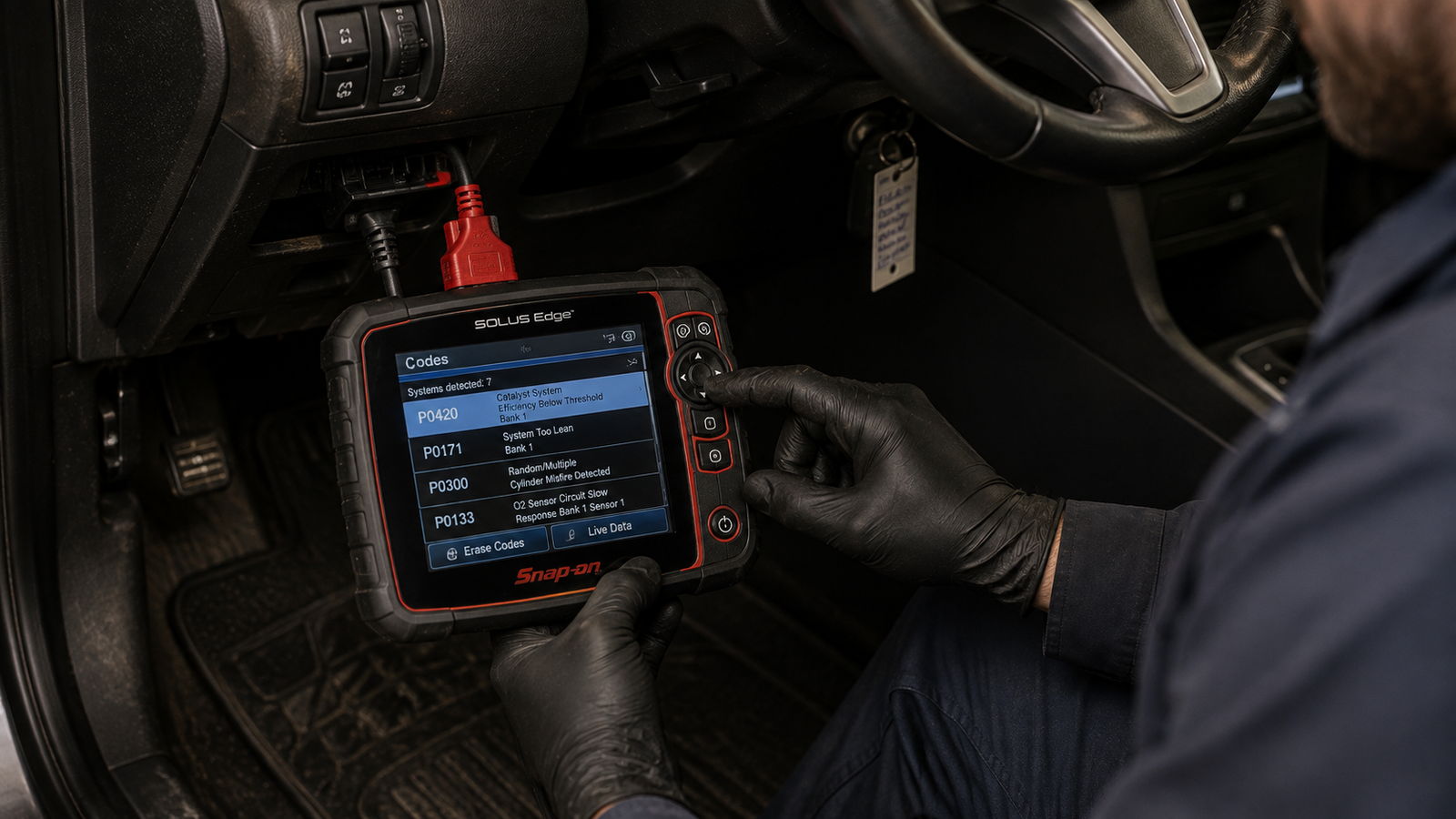
The amber ABS light means the anti-lock system has taken itself offline, most often because a wheel speed sensor is dirty, damaged or has a broken wire. Your normal brakes still work. What you have lost is the anti-lock function in a panic stop or on ice, which in a Michigan winter is not a small thing. It is not a tow-truck emergency, but it should not be ignored for months either, and it needs a scan tool to read the code rather than a guess. That side of the work lives on our diagnostics page.
A rattle or clunk over bumps
Here is the one that sends a lot of people to a brake shop when they do not need one. A rattle underneath, especially over bumps and at idle, is at least as likely to be a broken exhaust hanger or a heat shield as it is to be a brake component. Both make a tinny, loose sound from under the car. The easy tell: brake rattles usually change when you press the pedal, exhaust rattles usually change when you change engine speed. If yours is the second one, read the muffler and exhaust page instead. A hanger is one of the cheapest repairs on a car, and one of the most annoying to live with.
Quick triage
- Same day: grinding, a sinking or spongy pedal, a red brake warning light, a burning smell from one wheel
- This week: pulling to one side while braking, shaking or pulsing under braking, a caliper you suspect is dragging
- Book it soon: a steady squeal that does not clear after the first few stops, an amber ABS light, a handbrake that pulls up further than it used to
- Probably nothing: a brief squeal on the first stops of a damp morning that goes away
What “worn out” actually measures
Brake wear is not a matter of opinion, and this is the part most people are never shown. There are two numbers that decide the job.
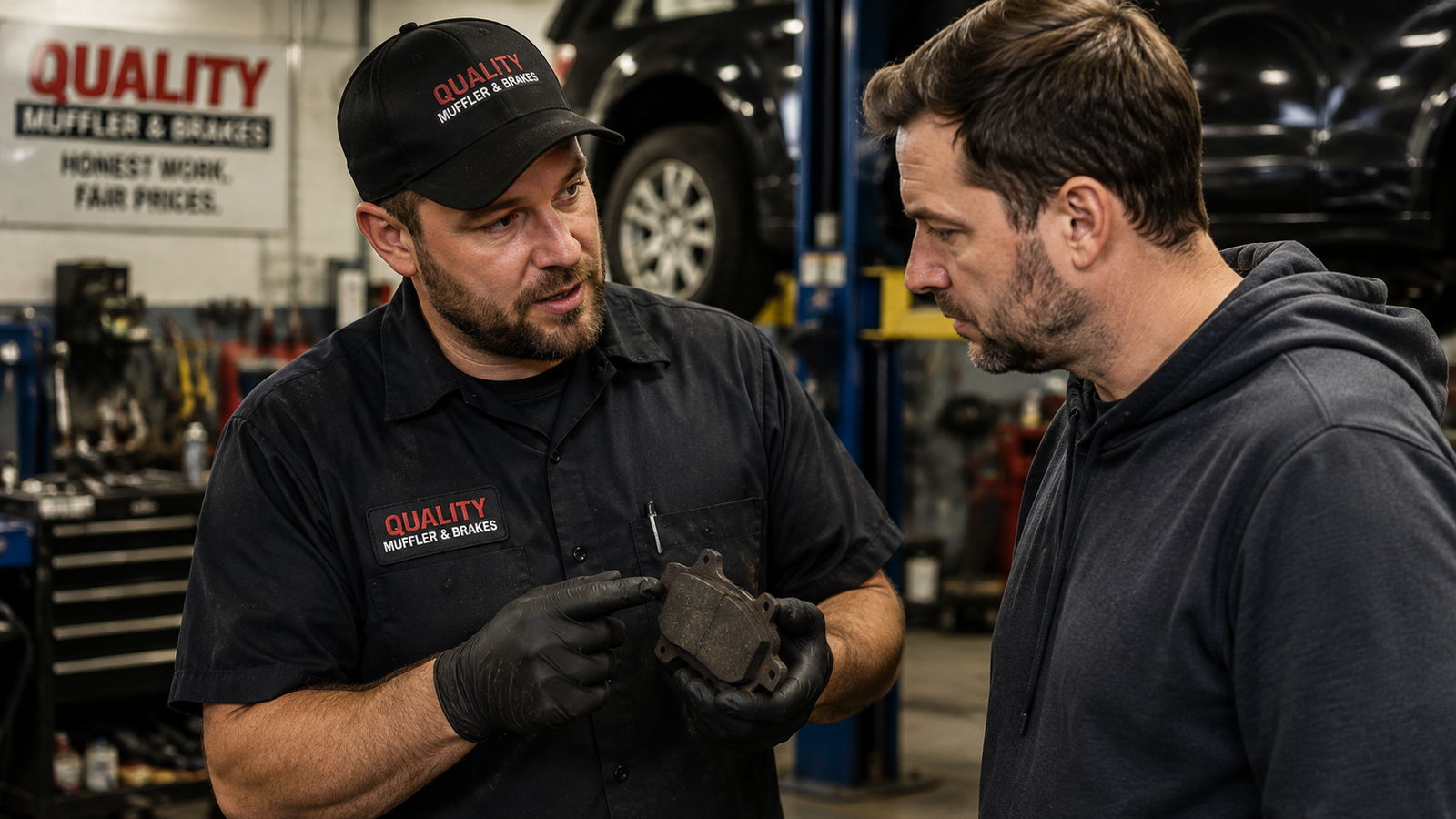
Pad thickness. A new pad typically starts with somewhere around 10 to 12mm of friction material. The wear indicator starts squealing at roughly 3mm. Below about 2mm there is nothing useful left. This is measured with a gauge, not judged by eye through a wheel spoke.
Rotor thickness. Every rotor has a minimum thickness cast or stamped into it by the manufacturer. Measured with a micrometer, a rotor is either above that number or it is not. If it is above and running true, it stays on the car. That is the whole argument, and it is why we hand you the measurements rather than adjectives. “They're getting low” is not a number.
Ask any shop for those two figures on your car. A shop that measures will tell you immediately. It is the single fastest way to work out who you are dealing with, and it is the first of the checks in our guide to telling an honest repair shop from a bad one.
Why Detroit is hard on brakes
Two local factors show up in almost every brake job we do here. The first is salt. Between the salted roads and the freeze-thaw cycle, corrosion attacks caliper slide pins, hardware clips and steel brake lines from underneath. We see rusted-through lines on cars that look perfectly healthy from above.
The second is stop-and-go city driving. Brake wear is a function of how many times you stop, not how many miles you drive. A car doing short trips across the neighborhood can wear a set of pads faster than one doing the same annual mileage on the freeway, which is why the mileage figure in the owner's manual is a rough guide at best.
If a car has been sitting for a few months, expect surface rust on the rotors and expect at least one caliper to have stiffened up. That is normal here, and it is worth an inspection before a long drive rather than after.
What a proper brake inspection looks like
Wheels off, all four corners, every time. Pad thickness measured and written down. Rotors measured and checked for runout and scoring. Calipers checked for free movement, torn boots and leaks. Hoses checked for swelling and cracking, steel lines followed for corrosion. Fluid checked for color and moisture content. Parking brake checked for travel and hold.
At our shop that inspection is free, and it stays free whether or not you have the work done. You get the numbers, a firm written quote before anything is touched, and the old parts if you want them. If something we find can safely wait, we will tell you that too, because the alternative is you never trusting the next thing we say.
What it costs, and what to do if the timing is bad
We do not publish a brake price, and we would rather explain why than post a number that changes at pickup. A brake job on a compact car with pads only and a brake job on a truck needing pads, rotors and a seized caliper are not the same work and should not carry the same figure. What we will commit to in writing is the process: the inspection costs nothing, the quote comes before the work, and the invoice matches the quote or you hear about it by phone first.
If the number lands at a bad moment, say so at the counter. The 101-day payment plan needs no credit, is approved while you wait, and exists precisely so that nobody drives around on grinding brakes waiting for payday. If you want the figure explained before you are standing at a counter, we wrote what actually sets the price of a repair.
If your car is doing one of these right now
Call the shop and describe it in plain words. You do not need to know the name of the part. “It grinds when I slow down, worse when the car is cold” is more useful to us than a guess at a diagnosis. Walk-ins are welcome six days a week, and we will get it on a lift and measure it.
We are at 14646 Fenkell Ave, west of Greenfield, which puts us a short drive from Grandmont Rosedale, Old Redford and Redford Township. Directions and hours are on the contact page.