
An oil change is the cheapest thing you will ever do for an engine, and it is the easiest to put off, because nothing bad happens the day you skip it. The damage is cumulative and quiet, and by the time you can hear it, the repair is not an oil change any more.
Here is what the oil is actually doing in there, what goes wrong when it stops doing it, and how to tell a real service interval from a number somebody picked because it is easy to sell.
Four jobs, not one
Most people think of oil as lubrication. It is, but that is only the first of four jobs, and the other three are the ones that decide how long the engine lasts.
It separates metal from metal. Your crankshaft does not touch its bearings. It rides on a film of oil a few microns thick. When that film thins or breaks, the two surfaces touch, and that is how bearings fail.
It carries heat away. Coolant handles the cylinder head and block. Oil handles everything coolant cannot reach: the pistons, the bearings, the turbocharger if you have one. A turbo shaft can spin past 100,000 rpm and oil is the only thing cooling it.
It keeps dirt in suspension. Combustion produces soot and acids. Detergent and dispersant additives hold that debris as tiny particles so the filter can catch it, instead of letting it settle out as sludge in the oil galleries and the pickup screen. When those additives are used up, the debris stops staying suspended. That is sludge, and it is the failure that turns an engine into a paperweight.
It seals. The film between the piston rings and the cylinder wall is part of what holds compression. Worn-out oil costs you a little power and a little economy before it costs you anything dramatic.
What is actually happening as it ages
Oil does not simply get dirty. Three separate things happen to it, and they happen on different clocks.
The additive package depletes. Detergents, dispersants, anti-wear additives and acid neutralizers are consumed as they do their work. This is the clock that matters most, and it runs on time and heat cycles as much as on mileage, which is why a service interval has a months figure next to the miles figure.
The oil shears. Multi-grade oil holds its viscosity across a temperature range using polymers, and those polymers break down under shear. An oil that started as a 5W-30 gradually behaves more like a thinner one.
It takes on contamination. Fuel dilution from short trips, moisture from condensation, soot from combustion. On a direct-injection engine, fuel dilution is a real factor, and it is worse in winter and worse on short runs.
What skipping it actually costs
We are not going to tell you the sky falls at 5,001 miles. What we will tell you is what we see on the lift when oil has been left far too long for far too many changes.
The cheap end is a timing chain that has stretched early, because chain guides and tensioners run on oil pressure and oil film. The middle is a set of variable valve timing solenoids clogged with sludge, which throws a check-engine light and a rough idle and gets misdiagnosed as something electrical. If your dash has lit up over something like that, the honest first move is a proper diagnostic scan and a look at the cause, not a parts swap.
The expensive end is bearing damage, and that is not a repair, that is an engine. Between an oil change and an engine replacement there is a factor of several hundred, and that is the entire argument.
How often, honestly
Start with the owner’s manual. On a modern engine running full synthetic the figure is usually somewhere between 5,000 and 10,000 miles, and there is a months figure alongside it that applies if you do not reach the mileage. Both matter.
Then read the second schedule, the one most manuals call severe service. It is not for race cars. It is for mostly short trips, a lot of stop-and-go, extreme heat or cold, dusty roads and towing. Read that list again and think about how you actually drive in Detroit. Most people here are on the severe schedule and do not know it, and that schedule is normally about half the mileage of the normal one.
If your car has an oil life monitor, it is better than a windshield sticker, because it is watching engine conditions rather than counting miles. It is not magic either. It cannot know that somebody topped it up with the wrong grade, or that you sat in traffic for forty minutes a day.
Why short trips are the hard case
This is the part almost nobody is told, and it is the single most useful thing on this page for a city driver.
Combustion produces water. On a long run the engine gets hot enough for long enough to boil that moisture out of the oil. On a short run it never does. The water stays, mixes with combustion acids, and starts corroding the inside of the engine while the car sits. Unburned fuel does the same thing, thinning the oil as it accumulates.
So the car that only ever does a two-mile run to work and back, the one with barely any miles on it, is often harder on oil than the car doing highway miles all week. Low mileage is not the same as low wear, and the months figure in your manual exists precisely for that car.
Which oil, and why the numbers matter
The grade on the bottle, say 5W-30, is two figures. The number before the W is how the oil flows when cold, where W stands for winter. The number after is how it behaves at operating temperature. A 0W-20 is not thinner than a 5W-30 when hot in a way that matters, it is thinner when cold, which means it reaches the top of the engine faster on a February morning.
Use what the manual specifies. Modern engines are built around a grade: oil pressure, bearing clearances and variable valve timing all assume it. Putting a heavier oil in a car that calls for 0W-20 to quiet a tick usually just delays oil getting where it needs to go at exactly the moment most engine wear happens, which is the first thirty seconds after a cold start.
Conventional, blend or full synthetic is the other axis. Synthetic resists shear and heat better and holds its additive package longer, which is why the intervals that go with it are longer. If your manual specifies it, treat that as a requirement rather than an upsell.
What should happen besides the oil
An oil change is often the only time in a year that a car is guaranteed to be on a lift with somebody underneath it. Wasting that is the real missed opportunity.
- Oil and filter, to the grade and capacity the vehicle actually calls for
- Fluid levels checked: coolant, brake, power steering, washer
- Pad thickness and tread depth measured and written down, not judged through a wheel spoke
- Belts, hoses and the battery looked at, because those are the parts that strand you
- A look along the exhaust and the suspension while the car is up there
At our shop that inspection is free, and it stays free whether or not you have any of the work done. You get the measurements either way. If you would rather know what those numbers mean before you are standing at a counter, our guide to brake warning signs spells out the two that decide every brake job.
How to tell a real recommendation from a sales target
Three honest tests, and there is a longer list in our guide to telling an honest shop from a bad one. First, ask for the number: pad thickness in millimeters, tread depth in thirty-seconds, a fluid that is dark or has tested positive for moisture. A shop that measures will tell you instantly. Second, ask what happens if you leave it. A straight answer, including “nothing much for now”, is the sign of somebody telling you the truth. Third, be careful with anything described as a flush that was not in your maintenance schedule and is not explained by a symptom.
We would rather tell you a repair can wait and have you come back than sell you something today and lose you.
Signs it has gone too long
- Oil on the dipstick that is black and thin rather than amber and slippery
- A ticking or tapping from the top of the engine on a cold start that fades as it warms
- The oil pressure light flickering, which is a stop-driving symptom, not a wait-and-see one
- An oil life monitor that has been at zero for a while
- You cannot remember the last one
The Michigan part
Cold starts are the hardest thing an engine does, and we get a lot of them here. Below freezing the oil is thicker, it takes longer to reach the top end, and a large share of an engine’s lifetime wear happens in those first seconds. That is an argument for the correct winter grade, and for not stretching an interval through a Michigan January.
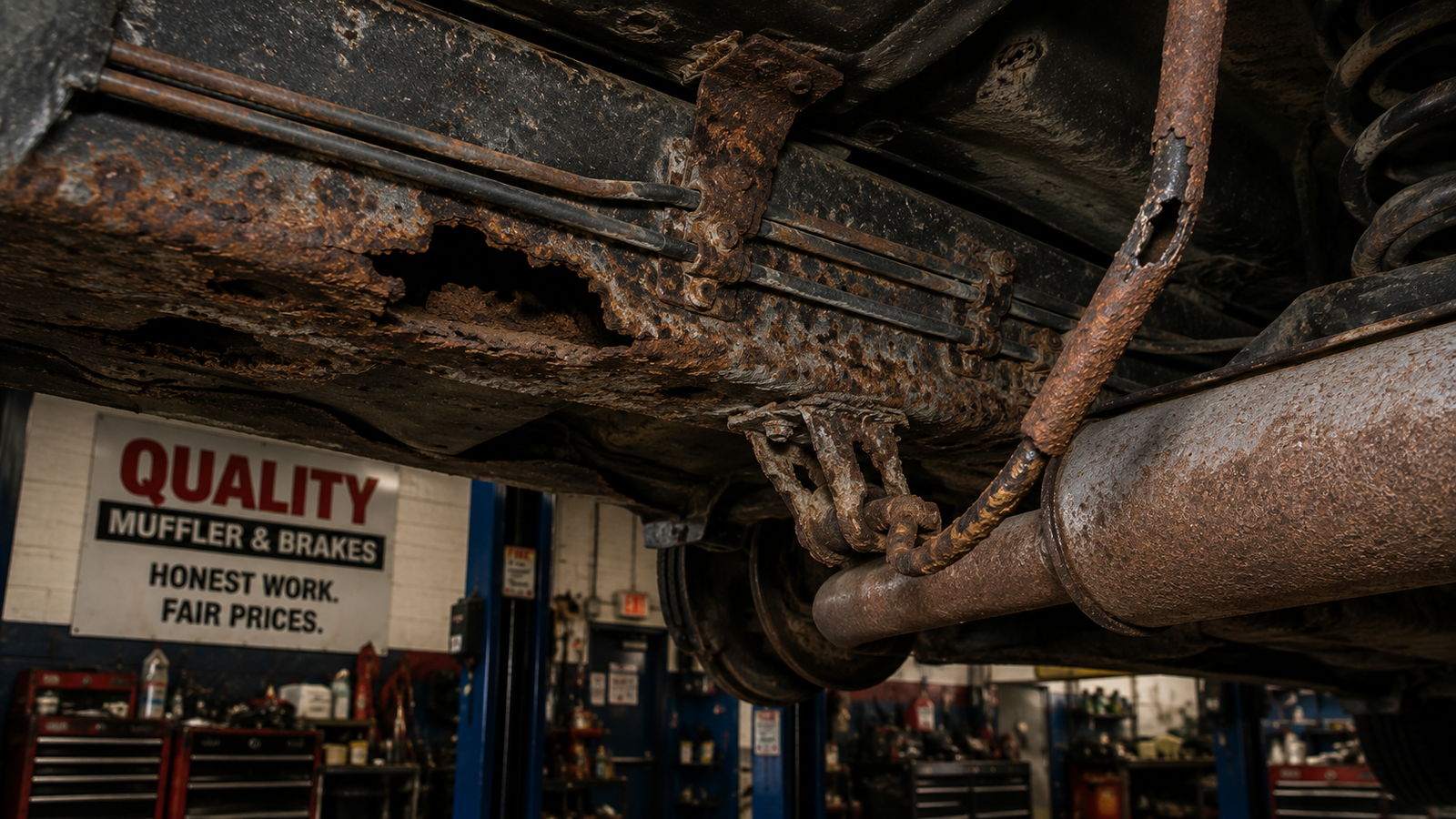
The other local factor is salt, and it is not an oil issue. It is the reason an oil change should always come with somebody looking underneath. Brake lines, fuel lines, exhaust hangers and subframe seams rust from below in this climate, and the only way to catch that early is for a person to be under the car with a light. If yours has got louder than it used to be, that is usually the exhaust rather than the engine.
Booking one
We are at 14646 Fenkell Ave, west of Greenfield, and walk-ins are welcome six days a week. Bring the car, tell us what it is doing, and you get the inspection numbers in writing along with the service. Drivers come to us from Redford Township, Livonia and Grandmont Rosedale; hours and directions are on the contact page. If the car turns out to need more than you expected, the 101-day payment plan needs no credit and is approved at the counter.