
Most people can live with a repair taking a day. What they cannot live with is not knowing, being told "it will be ready later" three times, and finding out at five o'clock that the part never arrived. The time matters less than the honesty about it.
So here are realistic figures for the work we do, and, more usefully, the things that actually make a job run long.
Roughly how long, by job
Oil change and inspection: about 30 minutes. That is on the lift, drained, filter, refill, and the free multi-point inspection with the measurements written down. Most people wait for it. The variable is not the work, it is how many cars are ahead of you.
Brakes: usually a couple of hours, same day. Pads and rotors on a common vehicle is not a long job. What makes it longer is what a Michigan winter has done to the hardware, which is covered below.
Exhaust: usually same day. This is the work the shop is named for and the welding is done here rather than sent out, which is the whole reason a section repair is a matter of hours instead of a week waiting on an assembly. Our exhaust page covers what that repair involves.
Diagnostics: the honest answer is that it varies, and that is the point. Reading a code takes two minutes. Finding out why the code is there can take an hour or several. An intermittent electrical fault or a parasitic drain is genuinely hard work, and any shop that promises you a fixed time for it before starting is guessing.
Tires, alignment and suspension: same day in almost all cases, unless something underneath has to come off that does not want to.
What actually makes a job run long
Four things, in roughly the order they happen.
Parts availability. We stock what we use most. Something unusual, an older vehicle, or a part that has to come from a supplier across town, adds hours or occasionally a day. This is the one we can almost always tell you about early, because we know within minutes of looking at the car whether we have what it needs, and you should hear it then rather than at closing time.
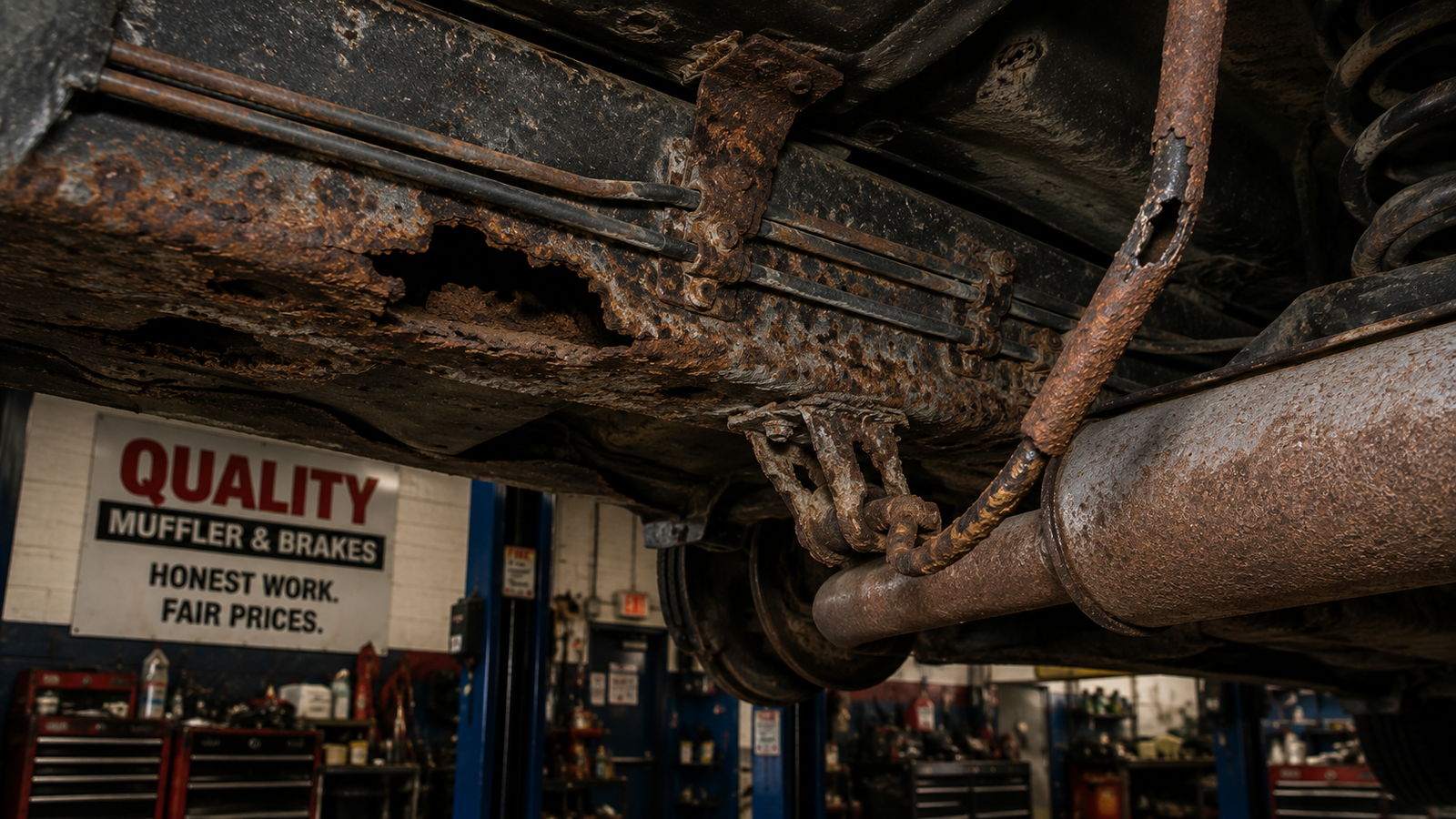
Seized and corroded fasteners. In this climate this is the big one. A bleeder screw that snaps, an exhaust bolt that shears in the manifold, a caliper bracket bolt that will not move: each of those turns a one-hour job into a two or three-hour job, and none of them are visible until a wrench is on them.
A second fault found once it is apart. Sometimes the thing that has been making the noise is hiding something else. That is not an upsell, it is what happens when a wheel comes off. What matters is that it gets quoted and approved separately rather than appearing on the invoice.
The bay queue. We are a walk-in shop six days a week, which is genuinely useful when your car is undrivable and slightly less useful when you turn up at the same time as four other people. A phone call before you drive over solves this entirely.
What "same day" honestly means
We say most repairs are finished the same day, and that is true, but it is worth being precise about what it means, because it is the sort of promise that gets abused.
It means that for the work we do most, on the vehicles we see most, with the parts we stock, the car goes out the same day it comes in. It does not mean every job, every vehicle, every time. When it is not going to be the same day, the useful thing is to be told that at 9am rather than 4:30pm, and that is the standard we hold ourselves to.
What to ask when you drop it off
- Roughly when will you know what it needs? (Usually within an hour of going up)
- Do you have the parts, or does something have to come in?
- Will you call me before doing anything, and on which number?
- If it turns into a bigger job, what is the realistic time then?
- What time do you close, and what happens if it is not done by then?
Any shop that answers those five straight is a shop worth leaving a car with. If you want the longer version of that test, we wrote one: how to tell an honest repair shop from a bad one.
What should happen when a job does run long
Jobs overrun. That is not the problem. What separates a shop worth using from one that is not is entirely in what happens next.
You should get a call, not a silence. It should come as soon as it is known rather than at the end of the day. It should say what changed, what the new time is, and what it does to the figure, because a job that grew usually grew for a reason that costs money. And if the answer is that the car has to stay overnight, that is a conversation, not an announcement made at closing time when you have no options left.
None of that is complicated. It is just a habit, and it is the habit most complaints about repair shops are actually about. The bill people remember as unfair is usually the one nobody warned them about, which is why anything found mid-repair here is quoted and approved by phone before it goes ahead. There is a longer version of that test in how to tell an honest shop from a bad one.
Planning around it
A few practical things that make the day easier, learned from watching people get caught out.
Come early if the car has to stay. A car that arrives at 8am and needs a part has most of a working day for that part to be fetched. The same car arriving at 3pm does not, and that is often the entire difference between same-day and next-day.
Take what you need out of the car before you hand over the keys. Obvious, and half the people who end up making a second trip did not do it.
Leave a number you will actually answer. The most common cause of a car sitting untouched on a lift is a shop waiting for approval on a voicemail nobody picked up.
Say up front if you have no other way to get around. It changes what we prioritize and what we recommend, and it is much easier to know at drop-off than at two in the afternoon.
Waiting versus leaving it
For an oil change, wait. It is half an hour and you get the inspection numbers before you leave.
For brakes or exhaust, leaving the car is easier on everybody, because the moment a job needs a decision from you, having you sitting in the waiting room does not actually speed anything up. But if you have no other way to get around, say so when you arrive. We would rather work around it than have you discover at noon that your only car is on a lift in pieces.
Before you drive over
Call and describe what the car is doing. Ninety seconds on the phone tells you how busy the bays are, whether we are likely to have the parts, and roughly what the job involves. If it is not safe to drive, say that first and we will tell you honestly whether to bring it or have it towed.
We are at 14646 Fenkell Ave, west of Greenfield, an easy run from Grandmont Rosedale, Old Redford and Redford Township. Hours, directions and a form are on the contact page, and if you want to know what the figure is likely to look like first, read what actually sets the price.