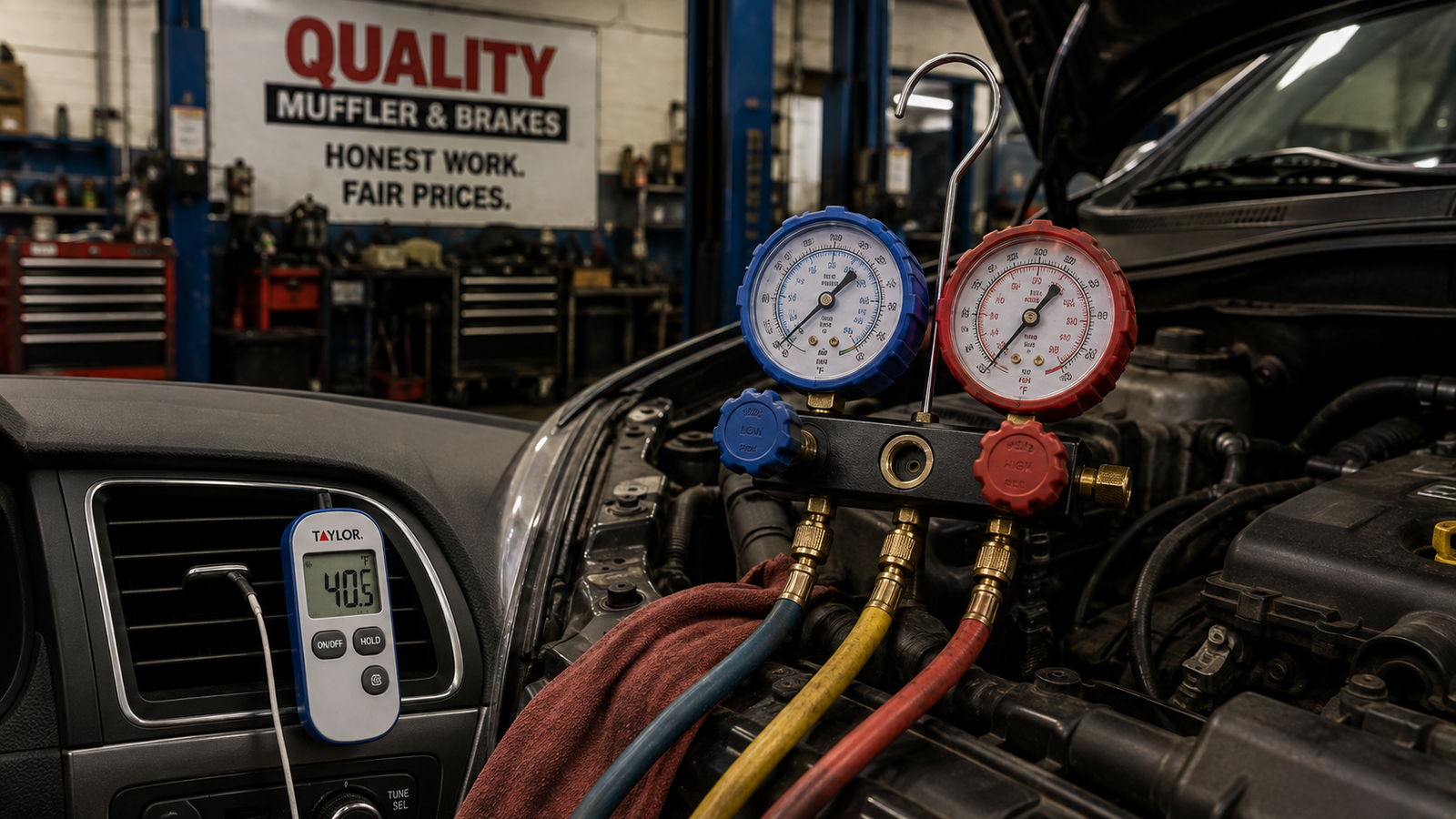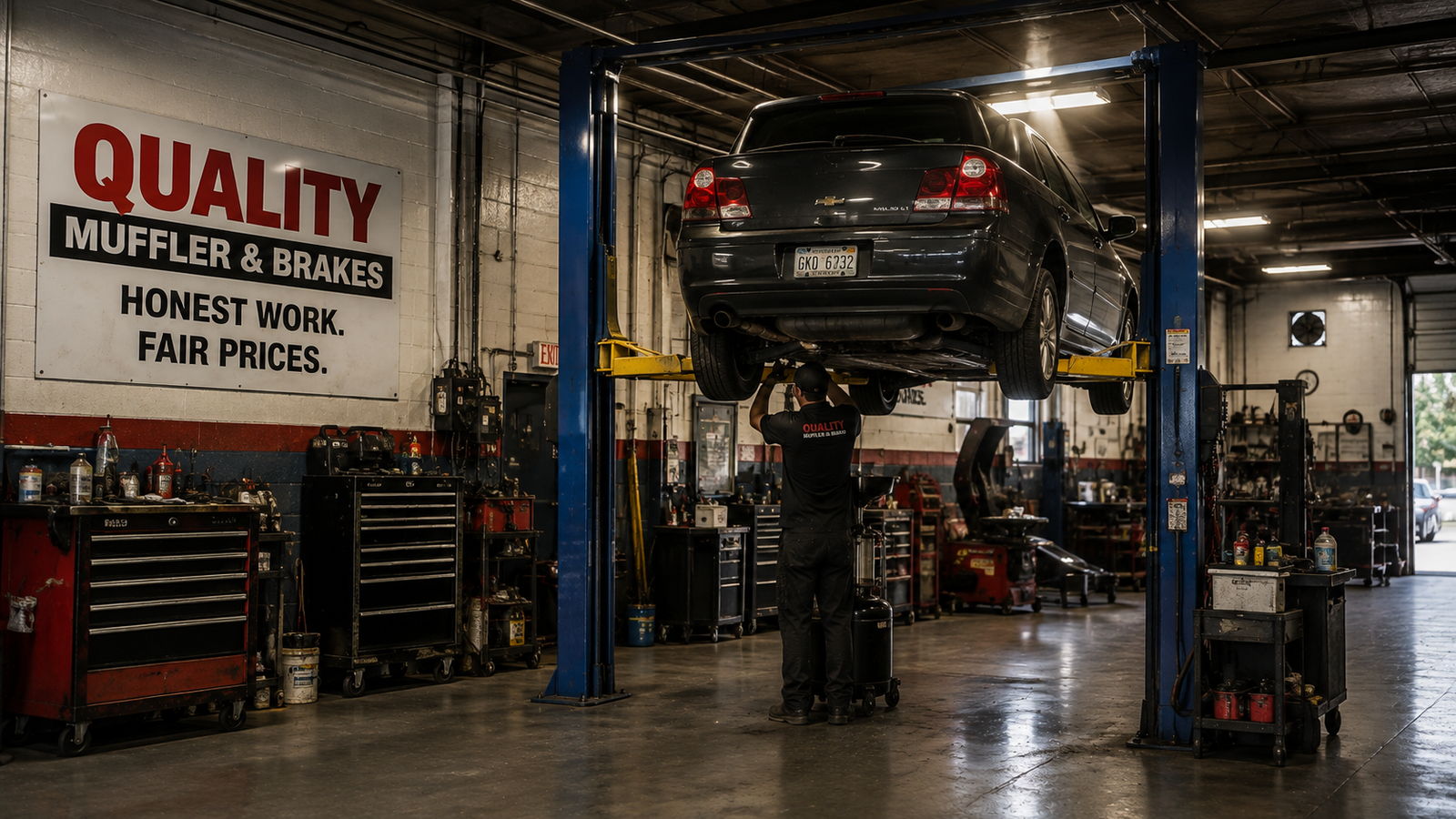

Almost nobody brings a car in for exhaust maintenance. They bring it in because it got loud. By then the cheap repair, a hanger or a clamp, has usually turned into a longer one. The system rots on a fairly predictable schedule in this climate, and knowing that schedule is most of the value on this page.
What the exhaust is actually for
Quieting the engine is the part you notice, and it is the least important of the four things the system does.
It gets combustion gas away from the people in the car. That gas contains carbon monoxide, which is colorless, has no smell, and is dangerous well before it is obvious. Everything else the exhaust does is secondary to that.
It manages backpressure. An engine is tuned around a certain resistance to flow. Too little and low-end torque suffers; too much and the engine is fighting to breathe out, which costs power and fuel.
It cleans the gas up. The catalytic converter turns the worst of what comes out of the engine into something less harmful, and the oxygen sensors around it tell the engine computer how well that is going.
It carries the sensors that make the engine run properly. Which is why an exhaust leak often shows up first as a check-engine light and a fuel economy complaint rather than as a noise, and why reading the code properly matters before anything gets replaced. Our guide to what a check engine light is actually telling you covers that in full.
The parts, front to back
Knowing the order helps, because the price of a repair depends almost entirely on how far forward the problem is.
- Manifold and downpipe. Bolted to the engine, the hottest part of the system, and it cracks more than it rusts
- Flex pipe. A braided section that lets the engine move without tearing the exhaust apart
- Catalytic converter. The expensive one, with an oxygen sensor before and after it
- Resonator. Tunes out specific frequencies, which is why some cars drone without one
- Muffler. The chambered box that does the actual quieting
- Pipes, hangers, clamps and the tip. The plumbing, and the parts that fail first
What rots first on a Michigan car
Exhaust systems here do not fail from the outside in the way you would expect. They fail from the inside out, and the order is consistent enough to plan around.
The hangers and clamps go first. Rubber isolators perish, the steel hooks they hang from corrode, and a section starts moving in a way it was never designed to. That movement is what cracks pipe further along. A hanger is one of the cheapest repairs on a car, and replacing one on time genuinely prevents a much larger bill.
Then the muffler, from the bottom seam. Water is a product of combustion and it collects in the lowest part of the system. On a car that mostly does short trips it never boils off, so it sits inside the muffler with combustion acids dissolved in it and eats through the seam from the inside out. That is why a muffler almost always rusts through at the bottom, and why the outside can look sound right up until it does not.
Then the pipe, at the low points and the joints. Same reason from the inside, plus salt spray from the road working the other direction.
The flex pipe, if the mounts have been loose. It is built to absorb engine movement, not to be the only thing holding a section up.
Why short trips wreck exhausts
It is worth saying plainly, because it is counter-intuitive: the car that does short runs around the neighborhood will often need exhaust work before the car doing highway miles, even with far fewer miles on it. The highway car gets hot enough for long enough to dry its exhaust out every day. The short-trip car never does, and it spends every night with acidic water sitting inside it.
If that is your driving, the useful habit is not to change how you drive. It is to have somebody look underneath once a year and catch the hangers before they take the pipe with them.
What each noise is telling you
A deep roar that rises with the engine. A leak, and the further forward it is the louder it gets. Loud from a cold start and quieter once warm often means a crack that closes as the metal expands.
A rattle over bumps or at idle. Usually a broken hanger letting something touch, or a heat shield that has lost a spot weld. Cheap. The useful tell: exhaust rattles change with engine speed, brake rattles change when you press the pedal. If it is the second one, our guide to brake warning signs is the page you want.
A drone at one particular speed. Frequently a resonator that has rotted through internally, or a section replaced at some point with the wrong part. Nothing is falling off, but it will wear you out on a long drive.
A hiss or a ticking that changes with load. A pinhole or a leaking gasket, often at a manifold, and usually worse when the engine is working going uphill.
A metallic scrape underneath. Something is now touching the road or the driveshaft. Do not drive it further than the shop.
The reason a leak is not just a noise
This is the paragraph we would keep if we could keep only one.
If you can smell exhaust inside the car, or if you get headaches, drowsiness or nausea on a drive that clear up once you are out of it, treat that as urgent and drive with the windows open until it has been looked at. Carbon monoxide is odorless, so what you can smell is other combustion products keeping it company, and the absence of a smell proves nothing at all. A leak ahead of the cabin, at the manifold or the flex pipe, is the one that puts fumes where you breathe them.
The catalytic converter conversation
Two things worth knowing before anybody quotes you one.
First, a P0420 code does not mean the converter has failed. It means the sensors before and after it are reading too much alike. That can be a genuinely dead converter, or a leak between the two sensors, or a lazy sensor, or an engine problem feeding the converter unburned fuel. Replacing the converter without finding out which one it is clears the code for a while and then does not, because whatever killed the first one is still there.
Second, converter theft is real here, and the sound is unmistakable: a car that was quiet yesterday and sounds like a race car today, from a standing start, with no gradual build-up at all. If that is what happened, it is usually worth a call to your insurer before the shop.
Repair or replace
The honest answer depends on what is left. If the rest of the system is sound we cut out the failed section and weld new pipe in, which is a fraction of the cost of an assembly and lasts as long as the metal around it. If the pipe crumbles when a wrench touches it, welding new steel to rust is not a repair, it is a callback, and we will say so.
That judgement needs the car on a lift and somebody underneath with a light, which is why we do not quote exhaust work over the phone, and why a confident phone quote is a warning sign. What we will do is put it up, show you where it is leaking, and give you a firm figure before anything is cut.
What exhaust maintenance actually looks like
- Once a year, have the underside inspected properly, ideally alongside the other seasonal checks
- Replace perished hangers and isolators when they are found, not when something breaks
- Rinse the underbody in spring after the salt season, if you have anywhere to do it
- Fix small leaks while they are small: heat and vibration only ever make a hole bigger
- Take a new rattle seriously enough to have it looked at, even though it is probably nothing expensive
Bringing it in
Exhaust is the work this shop is named for and the welding is done here, so most jobs are finished the same day. Walk-ins are welcome six days a week at 14646 Fenkell Ave, west of Greenfield, an easy run from Old Redford, Brightmoor and Redford Township. Hours and directions are on the contact page, the full service is described on our muffler and exhaust page, and if the timing is bad the 101-day payment plan needs no credit.